The Maths That Started It All
A sharp engineer did the rounds of the internet recently with a timeslip analysis that confirmed what Top Fuel tuners had suspected for years. Working backwards from trap speed, ET, and vehicle weight, the numbers proved that nitromethane-burning 500 cubic inch Hemis now produce north of 10,000 horsepower. Four-and-a-half seconds. 540 km/h. From standing still.

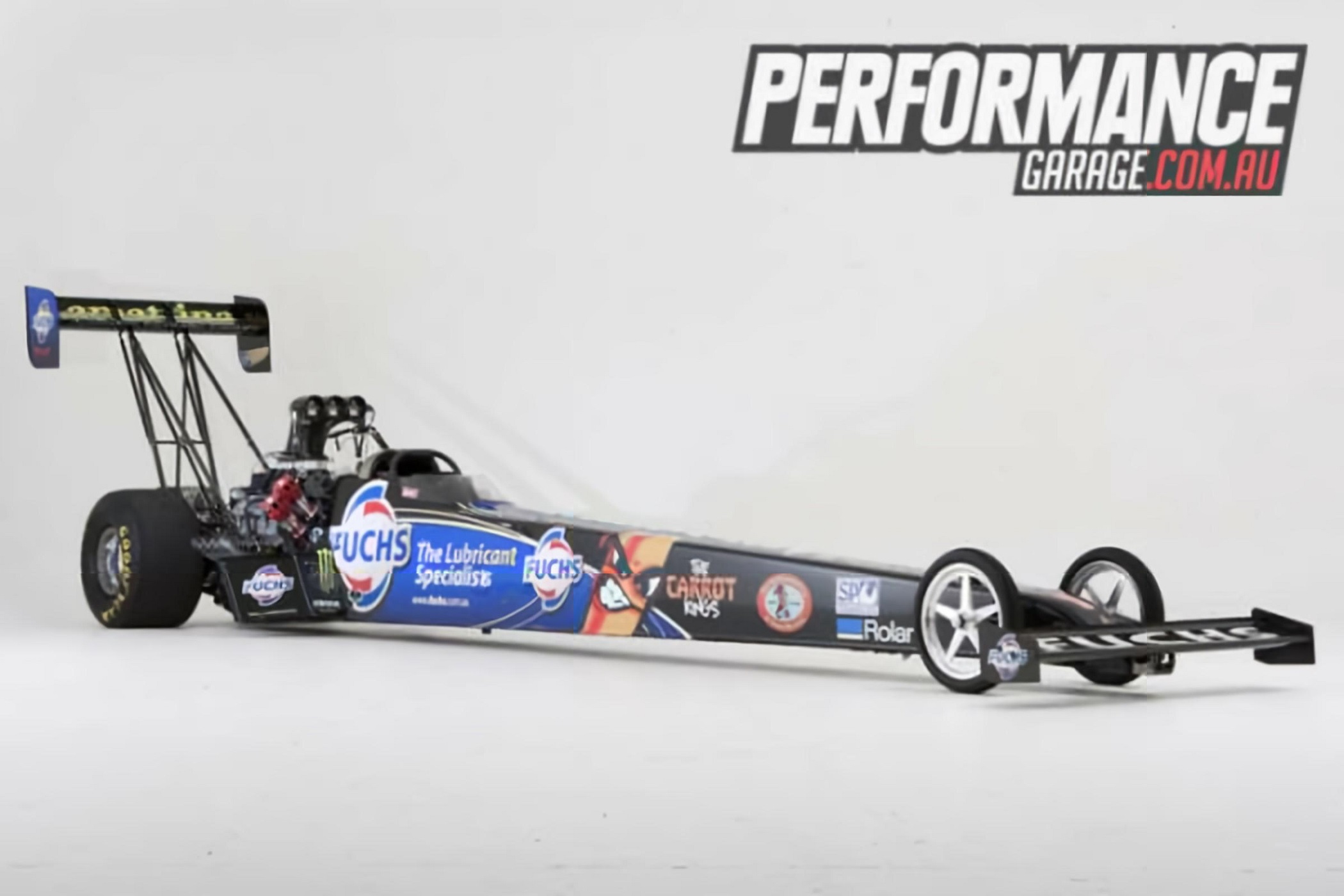
That figure sat in our heads for about thirty seconds before a different question took over. Forget the power. What does it cost to feed that kind of violence? We have covered the Australian Top Fuel Championship since its formation and spent enough time in the pits to know the between-rounds teardown is where the real story lives. So we called Aaron Hambridge, crew chief and head tuner for Lamattina Top Fuel Racing, to find out what a clean pass actually costs when nothing goes wrong.

Consumables: Every Single Pass
The phrase "every run" comes up constantly in Top Fuel. Parts that last a season in club racing get a single pass here. Aaron broke down the per-run consumables without hesitation, because these are numbers his team lives with every time they roll to the line.
We change conrod bearings every run, plugs every run, pistons last 2-3 runs, rings last 1-2 runs depending on how close you are to getting it right with the tune-up. At the Winternationals we went 4.60sec fine, 4.64sec throwing the belt off then 4.56 and scuffed 3 pistons. I got after it, ran too much boost and it went lean.
Aaron Hambridge, Crew Chief and Head Tuner, Lamattina Top Fuel Racing
Three pistons scuffed from a tune-up that pushed boost too far. That 0.08 second gap between the 4.64 and the 4.56 is where the money goes. Run it safe and the car is two tenths off pace. Chase the number and you risk melting $15,000 worth of parts in a single cylinder. Aaron lives in that gap every pass, and the Winternationals result shows exactly how narrow it is.
Blower belts we change every run. In qualifying we use a belt with 1 run on it and on race day we use a new belt every run. Those race day belts become qualifying belts for the next meeting or test session. Clutch discs we get 2-3 runs. Two new and three used every run. The new ones become the used ones for the next clutch pack. The steel floaters that run between the clutch discs we use for 1 pass and then they go in the bin.
Aaron Hambridge, Lamattina Top Fuel Racing
Nothing gets a second life at the level it first ran. A race-day blower belt becomes a qualifying belt. A qualifying belt becomes a test day belt. Steel floaters between the clutch discs are genuinely single-use. One pass, straight in the bin. No inspection, no measurement, no second chance. The cascade keeps consumable costs from being even worse than they already are, because a new belt for every qualifying session on top of every elimination round would add thousands more per event.
Fuel, Gaskets, and the Numbers That Add Up Fast
We go through 60-80L of nitromethane per pass. Head gaskets last 2-3 runs max. After that they're too squished from going on and coming off every run. We carry 300 gaskets in 0.001" increments from .050" to .100".
Aaron Hambridge, Lamattina Top Fuel Racing
Three hundred gaskets sorted in one-thousandth of an inch increments across a fifty-thou range. For context, a human hair is about three thou thick. Aaron's team is selecting sealing surfaces in fractions of that, because the combustion chamber pressures on nitromethane will find any gap the gasket leaves behind. Each one gets compressed and released two or three times before it loses the ability to seal, and the team needs the exact right thickness on hand for every assembly. Run out of the right size at the track and the engine does not go back together.
CRANKS CRACK FROM THE VERY FIRST HIT. YOU TRACK THE CRACKS TO DECIDE WHETHER YOU CAN USE THEM AGAIN.
The Valve Train and Bottom End
Lifters we change every two years. They're very expensive Jesel pieces. They're measured every run though. Pushrods we use them for quite a while. We don't usually burn them up. Sometimes you might wreck the cup from lack of oil but it's very rare. They're checked every pass though. The most laps we'll put on a conrod is 12. We have thrown them out after 1 run before though.
Aaron Hambridge, Lamattina Top Fuel Racing
Twelve passes maximum from a conrod. Sometimes one. The difference between a twelve-pass rod and a one-pass rod often comes down to how the tune-up loaded that particular cylinder during the run. A rod that catches one lean cycle on a cylinder running high boost can stretch or crack in ways that make it scrap immediately. Aaron and his team measure and inspect every single one after every pass to make the call.
We run 3 different piston heights in each engine to allow for variance in distribution. Piston height varies by about .030" to .040". We use 30L of oil every single pass. 10 litres for warm up that goes in the bin and then 20 litres for the pass. Caps and rotor buttons we change every 2-3 meetings as they burn out.
Aaron Hambridge, Lamattina Top Fuel Racing
Thirty litres of oil per pass. Ten of those litres exist purely to warm the engine up, then get dumped before the car even reaches the staging beams. The remaining twenty protect the internals during the actual 4.5 second run and are binned afterwards. No filtering. No recycling. At racing oil prices, that is several hundred dollars in lubricant alone for a quarter mile. But the alternative is worse. At the cylinder pressures a nitro Hemi produces, contaminated oil means a spun bearing, and a spun bearing at 8,700 rpm means a connecting rod through the block.
Cranks, Valves, and the Stuff That Bends
Cranks go 8 runs max. They crack from the very first time you stand on it. We track the cracks to determine whether we can reuse them. They crack in the radius usually but depending on the location, size and type of crack you can keep using them. Valve springs last 6 runs. The inconel exhaust valves last 6 runs and they bend every run from heat. We straighten them every pass and if they straighten too easily they go in the bin. The titanium intake valves last 20-30 passes.
Aaron Hambridge, Lamattina Top Fuel Racing
The crankshaft cracks on its first pass. Not its tenth. Not after a season. The first time 10,000 horsepower twists through it, the metal starts to fracture. Aaron's team tracks those cracks across up to eight passes, monitoring location, size, and growth pattern to decide whether the crank survives another run. A crack in the fillet radius between the journal and the web can be stable for several passes. A crack on the journal surface means it is done. When an exhaust valve straightens too easily, it means the inconel has lost structural integrity from repeated 1,800-degree heat cycles. That is the test. Not whether it is bent, because they all bend. Whether it resists being straightened.
Aaron's explanation of cylinder failure reveals a chain reaction that most people outside the sport would never consider. When a single cylinder drops out, the cam still opens the exhaust valve, pumping raw nitromethane out of the port. But because that cylinder has stopped scavenging air, the supercharger's output has one fewer exit point. Boost rises by 2-3 psi across the remaining live cylinders. Those cylinders were already running on the edge of the tune-up window. The extra 2-3 psi pushes them lean. And lean on nitro, at 50+ psi and 8,000+ rpm, means detonation.
The entire engine lets go because one cylinder stopped contributing. It is not the dead cylinder that kills the motor. It is the boost spike in the surviving cylinders that cannot handle the extra pressure. The failure cascades from one to all in fractions of a second.
Key takeaway: A Top Fuel tune-up operates on a razor edge where 2-3 psi of unplanned boost is the difference between a clean pass and a catastrophic engine failure. The tuner's job is to keep all eight cylinders alive for 4.5 seconds, knowing that losing even one triggers a chain reaction.
Chassis, Tyres, and the Long-Life Parts
Diff gears we get a long time out of, maybe 40-60 runs per set. Front tyres last one year. The front half of chassis lasts 100 runs and then it is cut off and front-halved. We only do that once then the whole chassis goes in the bin. 200 passes and that's it.
Aaron Hambridge, Lamattina Top Fuel Racing
A complete Top Fuel chassis has a total lifespan of 200 passes. At 100 runs, the front half gets cut off and replaced. That buys another 100 runs, then the entire frame goes in the skip. Two hundred clean passes, assuming nothing goes sideways along the way. If the car gets into the wall or has a major incident, those numbers shrink fast.
Parts Replacement Schedule
| COMPONENT | REPLACEMENT INTERVAL | NOTES |
|---|---|---|
| Conrod Bearings | Every pass | No exceptions |
| Spark Plugs | Every pass | No exceptions |
| Clutch Steel Floaters | Every pass | Straight in the bin |
| Blower Belts | Every pass (race day) | Demoted to qualifying duty after |
| Engine Oil | 30L every pass | 10L warm-up + 20L run, all binned |
| Piston Rings | 1-2 passes | Tune-up dependent |
| Pistons | 2-3 passes | 3 different heights per engine |
| Head Gaskets | 2-3 passes | 300 gaskets in 0.001" increments |
| Clutch Discs | 2-3 passes | Cascade system: new → used → bin |
| Valve Springs | 6 passes | Measured every run |
| Exhaust Valves (Inconel) | 6 passes | Bend every run, straightened and tested |
| Crankshaft | 8 passes max | Cracks from first pass, tracked until unsafe |
| Conrods | 12 passes max | Sometimes 1 pass only |
| Titanium Intake Valves | 20-30 passes | Relatively long-lived |
| Diff Gears | 40-60 passes | Longest-lasting drivetrain component |
| Chassis (front half) | 100 passes | Cut off and replaced once |
| Chassis (complete) | 200 passes | Then binned entirely |
The Bottom Line
Add it all up and a single clean pass down the quarter mile costs $15,000. That is the baseline. Everything goes to plan. The car goes from A to B without any unexpected damage. No scuffed pistons, no dropped cylinders, no incidents on the strip. Fifteen grand for 4.5 seconds of work.
Now multiply that by a race day. If a team qualifies and makes the final, that is seven passes across qualifying and eliminations. Seven times fifteen thousand. Over a hundred grand in consumables alone, before you account for crew wages, freight, entry fees, fuel transport, or any of the damage that happens when things go wrong.
A clean race day with four qualifying passes and three elimination rounds costs approximately $105,000 in consumables. One engine failure from a dropped cylinder or lean event can add $30,000 to $50,000 on top. A blower explosion or major mechanical incident pushes costs even higher. These figures do not include crew, logistics, or entry fees.
The numbers get properly wild when you break them down by time. A Top Fuel pass costs $15,000 for 4.5 seconds of racing. That works out to $3,333 per second of full-throttle competition. For comparison, a single F1 power unit costs approximately $11 million and lasts around seven race weekends. Divide that engine cost across roughly 90 minutes of racing per event and F1 comes to about $291 per second on engine alone. Even when you factor in a full F1 race weekend budget of $15 to $20 million per team (crew, logistics, tyres, damage, everything), the per-second cost lands around $3,200.
Top Fuel matches or exceeds F1's per-second cost with consumables alone, before crew wages, freight, or entry fees. And F1 teams operate under a $135 million annual budget cap with global television revenue, factory sponsorship, and constructor prize money. In Australia, Top Fuel runs on private funding from three committed team owners.
Key number: $3,333 per second. That makes Top Fuel the most expensive form of motorsport per second of racing on the planet.
Australia currently has three active Top Fuel teams chasing the Burson Auto Parts Australian Top Fuel Championship: Rapisarda Autosport International, Jim Read Racing, and Lamattina Top Fuel Racing. Peter Xiberras retired from driving after back-to-back titles and PremiAir Racing stepped back from the grid. That leaves three teams shouldering $15,000-per-pass costs across a six-round national series, funded almost entirely by private investment and personal sponsorship deals. The sport's survival in this country sits on a very small number of shoulders.
The clip below shows a Lamattina Top Fuel pass from the cockpit view. Pay attention to the first 100 feet after launch. The engine drops from 8,700 rpm to about 6,500 as the clutch takes up load, then climbs back to 8,700 by the finish line. That rpm recovery curve is Aaron's tune-up working in real time. Every disc, every floater, every belt Aaron described above is doing its job for exactly 4.5 seconds.
Interview conducted with Aaron Hambridge, Lamattina Top Fuel Racing | performancegarage.com.au