What Happened in Shanghai
Piastri qualified fifth, Norris sixth. Not brilliant, but not disastrous. Mercedes locked out the front row. Kimi Antonelli grabbed pole, the youngest in Formula 1 history at 19 years and 6 months, with George Russell slotting in behind. The Ferraris of Lewis Hamilton and Charles Leclerc took row two. McLaren was off the pace. Piastri flagged a grip issue across the weekend and the team found a persistent sector-three deficit to Mercedes they could not trace back to any single setup parameter. The gap to pole was 0.6 seconds. In 2024, that would have been a bad day. In 2026, it might be where McLaren actually is.
Then Sunday.
The Double DNS
The reigning world champion. Twenty minutes before his car was due to leave the garage, the team found an electronics fault. Mechanics pulled the floor off to access the problem. They thought they had it. The car would not start. Norris sat in the cockpit for several minutes, helmet on, waiting for word. The MCL40 stayed dead. He hung around the garage through the opening laps hoping a red flag might buy extra time, but the call eventually came. First non-start of his entire F1 career. 112 previous race starts, every single one of them he at least made the grid. Not this time.
Piastri's car actually made it to the grid. Everything checked out on the installation lap from the garage. Then, seconds before the formation lap, a separate electrical fault hit his power unit. Different system, same outcome. Mechanics ran to the car. They could not fix it. The MCL40 was wheeled back to the pit lane and Piastri climbed out. He described it as "an electrical issue on the power unit" and the team later confirmed it was a different root cause from the Norris failure.
McLaren confirmed the two failures were separate electrical problems on the power unit side. Team principal Andrea Stella announced McLaren has launched an investigation with Mercedes HPP (High Performance Powertrains) to understand both faults. Neither issue had been present after the Sprint Race or qualifying on Saturday.
Melbourne: The First DNS
The China DNS makes more sense when you know what happened in Melbourne. A week earlier, Piastri qualified fifth for his home Grand Prix at Albert Park. Reasonable grid slot. But on the reconnaissance lap, the slow drive from the pit lane to the grid that should be the most unremarkable part of the entire weekend, he lost control exiting Turn 4.
His MCL40 caught the exit kerb, snapped sideways, and hit the concrete barrier hard enough to destroy the front-right corner. Race over. Forty minutes before lights out, on a lap where drivers are barely pushing, the car was in pieces. That is the part that needs explaining.
Three factors combined, and the third one is the one that matters for every team on the 2026 grid:
I was at less throttle than what I was in qualifying… I actually got 100kW more power than if I would have been at full throttle.
Oscar Piastri, post-race, MelbournePiastri accepted partial blame. "A big element of that was me," he said. Fair enough. But the systemic issue is bigger than one driver getting caught out. The 2026 power unit regulations have created a car that can dump 100kW of unexpected torque through the rear wheels with no warning. That is not a McLaren problem. It is a regulation problem. Verstappen, Russell, and multiple midfield drivers reported the same empty battery behaviour on their recon laps. Piastri was just the one who hit the wall.
The 2026 energy recovery system runs a 350kW electric motor alongside the ICE, up from roughly 120kW under the old rules. When the battery depletes mid-lap, the transition back to full combustion power is supposed to be managed by software. At Albert Park, the software sent Piastri a torque spike at the exact moment he was on cold tyres, riding a kerb, mid-shift. The margins vanished.
The 2026 regulations tripled the electrical component of the power unit. Under the old rules, the MGU-K produced around 120kW. The new spec pushes that to 350kW. That is not an incremental change. It is a fundamental redesign of how an F1 car generates and distributes torque.
The problem is the battery-to-ICE handoff. When the battery state drops to zero mid-lap, the power unit software needs to transfer the torque load back to the combustion engine without a spike. In testing, this works. On race weekends, when batteries deplete faster than models predict due to formation lap procedures, recon lap speeds, and variable ambient temperatures, the handoff window compresses. The software runs out of time to manage it smoothly.
The result is torque spikes. Piastri's Melbourne crash was a torque spike. The Shanghai electrical faults may be related to the same power management architecture overloading under conditions the software was not calibrated for. Mercedes HPP, Ferrari, and Red Bull Powertrains are all wrestling with variants of this problem. It is the defining technical challenge of the 2026 season, and nobody has solved it yet.
Key number: Piastri reported receiving 100kW more than full-throttle power at the moment of his Melbourne crash. That is roughly equivalent to the entire MGU-K output of a 2025 car being dumped through the rear axle in a fraction of a second. On cold tyres, on a kerb, that is unrecoverable.
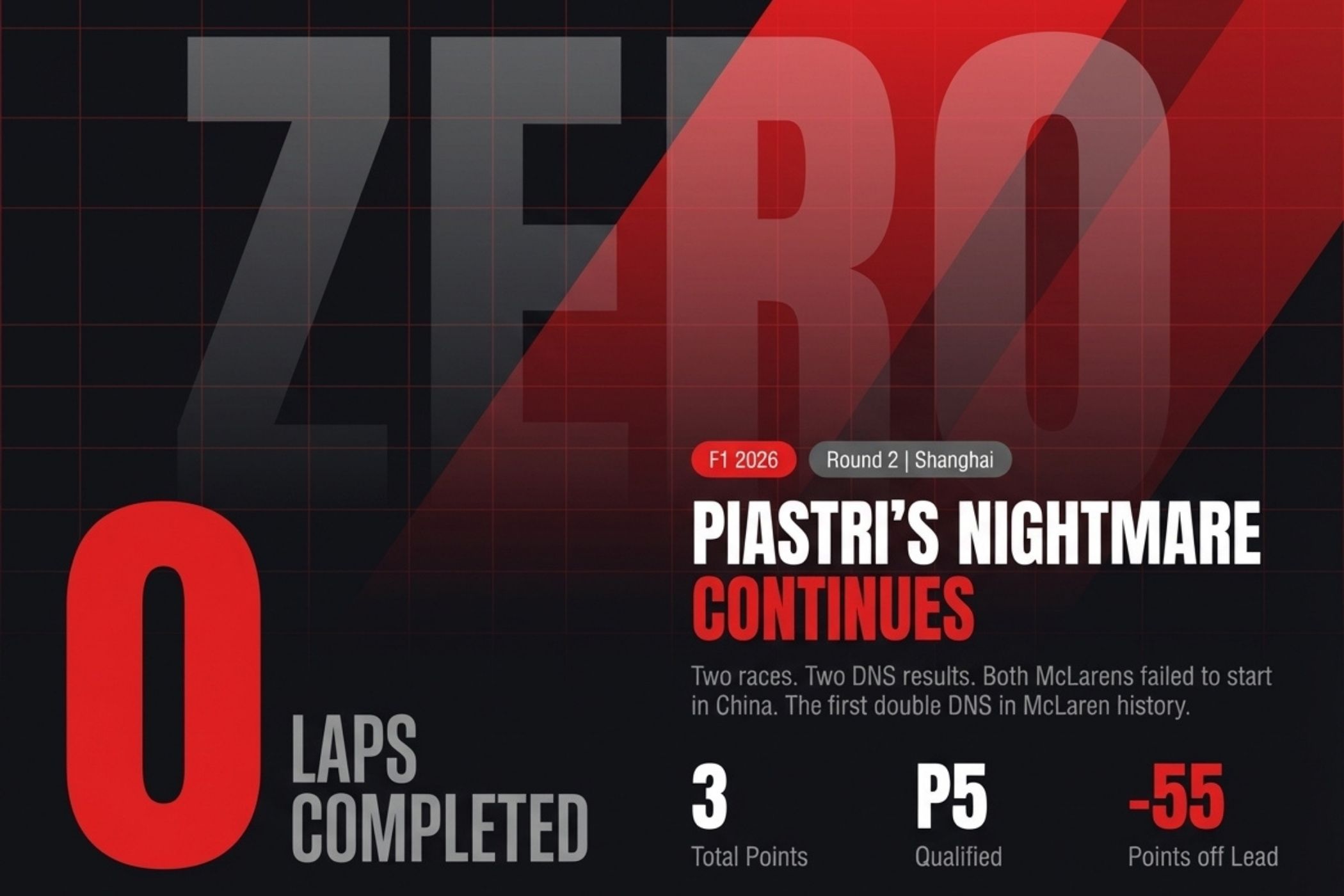
Two races. Zero laps. The last driver to record consecutive DNS results for McLaren was Bruce McLaren himself in 1969.
The Unwanted Record
Consecutive DNS results are almost unheard of in modern F1. The last driver to manage it at McLaren was Bruce McLaren himself, at the 1969 United States and Mexico Grands Prix. That was 57 years ago. Different sport, different era, completely different reliability picture. Piastri is now in a statistical bracket that barely exists.
GPFans gave it a name: the "unwanted F1 Triple Crown." A DNS, a DNF, and a DSQ. Piastri collected the DSQ in Las Vegas 2025, when he and Norris were both disqualified for illegal plank wear. So in the space of four months across two seasons, the 24-year-old has found three different ways to not finish a race.
There is a strange footnote to the Melbourne story. In 2015, a ten-year-old Piastri was supposed to be a grid kid for Daniil Kvyat at Albert Park. Kvyat's Red Bull broke down on the way to the grid. DNS. Eleven years later, same circuit, same outcome, except now it was Piastri in the cockpit. He tracked down the kid who was assigned as his grid kid at Melbourne 2026 and sent him a video message. Whether that gesture was reassurance or apology depends on how you read it.
Championship Damage
| Pos | Driver | Team | Points | Gap |
|---|---|---|---|---|
| 1 | George Russell | Mercedes | 58 | - |
| 2 | Kimi Antonelli | Mercedes | 54 | -4 |
| 3 | Charles Leclerc | Ferrari | 41 | -17 |
| 4 | Lewis Hamilton | Ferrari | 40 | -18 |
| 5 | Lando Norris | McLaren | 18 | -40 |
| - | Oscar Piastri | McLaren | 3 | -55 |
McLaren sits on just 18 points combined (15 Norris, 3 Piastri from the Melbourne sprint). Mercedes leads the constructors' on 112, Ferrari on 81. McLaren is already 70 points behind Mercedes after only two rounds.
In 2024, McLaren overhauled Red Bull's constructors' lead by averaging roughly 12 points per weekend more than their rivals across the final 14 races. That took five months. To claw back 70 points from Mercedes at the same rate, McLaren would need six clean weekends of dominance. They have not completed a single Grand Prix between both cars in 2026.
The drivers' championship is mathematically wide open. Twenty-two races remain and the points system awards 26 per weekend (25 race + 1 fastest lap) plus up to 8 from sprints. But Piastri's problem is not maths. His problem is reliability. Points require laps. He has done zero.
The Race He Missed
While Piastri sat in the McLaren garage watching on a monitor, a 19-year-old won his first Grand Prix. Kimi Antonelli, 19 years and 202 days old, became the second youngest race winner in F1 history. Only Verstappen was younger. Antonelli briefly lost the lead to Hamilton at the start but retook it before the end of lap 2 and was never headed again, winning by 5.5 seconds. Piastri is 24, entering his fourth season, and has zero completed Grand Prix laps. The contrast does not need commentary.
Hamilton was having the best race of his Ferrari career. Leclerc and Hamilton swapping positions lap after lap, genuine wheel-to-wheel racing from two teammates who clearly wanted the same piece of road. Meanwhile, in the McLaren garage, the defending constructors' champions had two dead cars, two empty pit boxes, and a television showing them everything they were missing.
The attrition rate was brutal. Seven of the 20 entries failed to see the chequered flag. Four did not start: both McLarens, Audi's Gabriel Bortoleto (hydraulics), and Williams' Alex Albon (suspension failure identified on the grid). Three retired during the race: Verstappen's ERS coolant failure on lap 45, plus both Aston Martins. Alonso lost power on lap 31; Stroll parked it six laps later with an identical symptom. That is a 35% attrition rate. In 2024, the average was closer to 12%. The 2026 power units are faster but they are fragile, and Shanghai exposed it.
Haas's Oliver Bearman finished fifth. Haas. Ahead of Red Bull in the constructors' standings. Ahead of McLaren, the team that won the constructors' championship 12 months ago. After two rounds, the 2024 constructors' champion and the four-time drivers' champion both scored zero in the same race. Bearman, 20 years old and in his first full season, outscored both of them combined.
The Bigger Picture
Twelve months ago, McLaren won the constructors' championship. Norris was crowned world champion. They were the team to beat heading into the regulation reset. That matters because it frames how far the fall has been. This is not a backmarker having a bad weekend. This is the reigning champion constructor failing to start a race with either car.
The MCL40 runs a Mercedes power unit, and the electrical issues that killed both cars in Shanghai appear to originate on the Mercedes HPP side, not McLaren's chassis. That is a problem McLaren cannot fix in their own wind tunnel or simulator. They are dependent on Brixworth finding the fault and Brixworth has its own crisis: the same power unit sits in the back of the Williams that DNS'd and the Aston Martins that retired. Four Mercedes-powered cars failed to finish in Shanghai. Four.
The worst. These are the worst cars.
Lando Norris, on the 2026 regulationsVerstappen has been equally direct, warning that the current regulations will "come back and bite them in the ass." Neither driver was being theatrical. The 2026 energy recovery system produces roughly three times the electrical power of the outgoing regulations. When it works, the cars are extraordinarily fast. When the software misjudges the battery state, drivers get torque spikes they cannot anticipate. That is what put Piastri into the wall at Albert Park and it is what keeps triggering electrical faults across multiple teams.
For Piastri personally, the slide started before 2026. His late-2025 form told a story the results barely captured. Three podiums across the final nine races. A crash in Baku. A crash in Brazil. Thirteen points behind Norris in the final standings, which does not sound like a lot until you remember they were driving the same car. He finished 2025 with a disqualification in Las Vegas, plank wear, shared with Norris. The winter break was supposed to reset the picture. Two rounds in, it has gotten worse. Three championship points, all from sprint races. Zero completed Grand Prix laps. Every single point he owns came from shorter, lower-intensity formats where the power unit was under less stress. That pattern is not a coincidence.
What's Next
F1 has a two-week gap before the Japanese Grand Prix at Suzuka, 27 to 29 March. McLaren and Mercedes HPP will spend that window pulling both power units apart. The fact that the two Shanghai failures had different root causes is actually the worse outcome for the team. One common fault would mean one fix. Two separate faults means the electrical architecture has multiple vulnerability points, and finding them takes longer.
Try and learn what we can by watching the race, then after that just trying to do as much work as we can before Japan. The problems today have been annoying, but besides that we know we've got work to do to find more performance.
Oscar Piastri, post-race, ShanghaiRead that quote again. He is not angry. He is not throwing the team under the bus. He watched an entire Grand Prix from the garage, his second consecutive DNS, and his public response is measured and professional. That restraint is one reason McLaren rates him so highly.
But restraint does not fix the standings. Piastri is 55 points behind Russell with 22 races remaining. The maths is not impossible, but it requires finishing races. Suzuka's layout is punishing on power units: long straights, high-speed corners, and the 130R compression that loads the ERS harder than almost any other circuit on the calendar. If the Mercedes power unit has a systemic weakness, Suzuka will find it.
He needs a clean weekend. Not a podium, not a miracle recovery drive. Just 56 laps of an F1 car doing what it is supposed to do. Antonelli has a win, Russell has the championship lead, Hamilton has his first Ferrari podium. Piastri has a sprint result and a video message to a grid kid. After Melbourne and Shanghai, finishing a Grand Prix would count as progress.
Compiled 15 March 2026 | Sources: formula1.com, motorsport.com, planetf1.com, racingnews365.com, skysports.com, crash.net